

Emerging CFO Program
Invalid liquid data
Invalid liquid data
Emerging CFO Program: Lead finance strategy and drive value creation
Led by renowned Wharton faculty, this six- to eight-month program blends financial leadership, corporate finance, and organizational dynamics with electives tailored to your goals. You will gain advanced leadership skills, global perspectives, and the tools to communicate effectively with stakeholders, drive strategic financial decisions, cultivate influence across the enterprise, and position yourself for success as a future CFO.
84%
76%
76%
Source: EY
What will you learn in the Emerging CFO Program?
Key program takeaways
The Emerging Chief Financial Officer Program helps finance leaders strengthen strategic thinking, enterprise leadership, financial expertise, and C-suite readiness in an increasingly complex business environment.
Strategic decision making: Identify and use tools and data-driven insights to make informed strategic financial and organizational decisions
Risk and adaptability: Excel at managing risk while embracing global adaptability and ethical decision making
Financial leadership: Become a strategic leader who shapes finance with foresight and integrity
Stakeholder influence: Build trust, manage relationships, and communicate with a broad range of stakeholders in a transparent and impactful manner
Organizational partnerships: Understand organizational dynamics to build the alliances and partnerships needed to be a proactive and effective presence in the C-suite
Innovation mindset: Cultivate innovation to navigate global challenges and the future of finance with confidence and agility
Transformational leadership: Foster a culture that prioritizes ethical decision making while inspiring and leading diverse teams toward achieving cohesive and transformative goals
Learning journey for the Emerging Chief Financial Officer Program
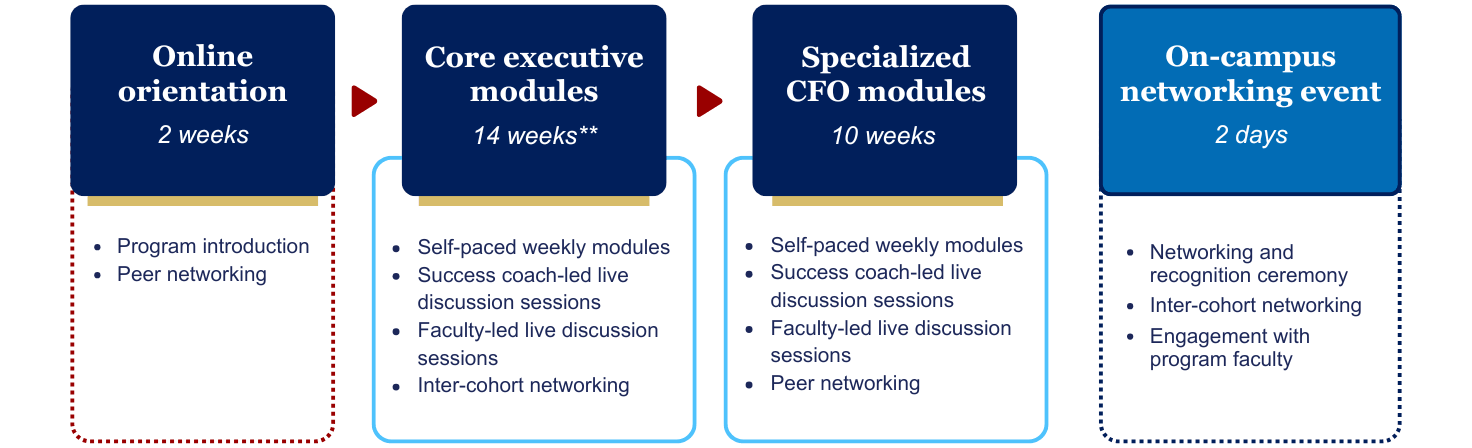
Core executive modules: 14 weeks of leadership development focused on decision making, influence, strategy, organizational effectiveness, sustainability, and change leadership
Specialized CFO modules: 10 weeks of focused modules on Upskilling Advancement and Transformation Mindset covering effective decision-making strategies and nuances of modern financial leadership
Live faculty-led sessions: A series of live sessions focused on leadership development, financial leadership, and strategic decision making
Leadership-development action plan: Create a personalized road map to strengthen leadership capabilities and prepare for future CFO responsibilities
Capstone project: Apply program concepts to an extended case study and develop a strategic framework for organizational impact
Optional on-campus event: A two-day recognition ceremony and networking event on the University of Pennsylvania campus in Philadelphia
*Note: A registration fee of US$250 is applicable.
**Note: The last two weeks of core modules will be held after the 10 weeks of specialized phases.
How is the Emerging CFO Program curriculum structured?
Core executive modules | 14 weeks | Essential leadership skills
Build the leadership, strategic thinking, and organizational capabilities required to lead effectively across functions, stakeholders, and enterprise priorities.
Foundations of Effective Leadership
Develop the core leadership skills needed to improve decision making, strengthen teams, and build organizational influence.
Leadership and Decision Making – Explore frameworks for making effective decisions in complex and uncertain environments.
Team Empowerment – Learn how to develop high-performing teams and create conditions for sustained success.
Collaborative Networks – Understand how strategic relationships and networks contribute to leadership effectiveness.
Organizational Power – Examine how influence and power dynamics shape organizational outcomes.
Purpose-Driven Strategy – Explore how purpose can be aligned with strategy to drive organizational performance.
Leadership Journeys – Assess leadership growth through practical examples and real-world leadership experiences.
Leadership-development action plan
Create a personalized road map to strengthen leadership effectiveness and support your progression toward the CFO role.
Leading through Complexity
Develop the ability to navigate uncertainty, influence stakeholders, and lead responsibly through changing business environments.
Mastering the Art of Influence – Build influence strategies that help drive alignment and organizational impact.
Innovative Leadership – Explore approaches to leading innovation and fostering adaptability within organizations.
Analyzing Future Trends – Assess emerging business trends and their implications for future leadership decisions.
The Role of the C-Suite in Driving Digital Transformation – Examine how senior leaders guide digital transformation initiatives across the enterprise.
Integrating ESG into Strategic Decision Making – Understand how ESG considerations influence long-term strategy and business performance.
Understanding and Appreciating Diversity in the Workplace – Explore how diverse perspectives contribute to stronger organizational outcomes.
Leading for Long-Term Sustainability and Growth
Learn how finance leaders support sustainable growth, strategic partnerships, and organizational resilience.
Strategic Partnerships – Evaluate how partnerships can create value and support long-term organizational goals.
Leading through Change – Develop strategies for leading teams and organizations through transformation and disruption.
Specialized CFO modules | 6 weeks | Upskilling advancement
Build a stronger foundation in corporate finance, capital allocation, valuation, and strategic financial decision making to prepare for enterprise-level leadership responsibilities.
The Cost of Capital and Valuation: Optimizing Investment Decisions – Understand valuation principles and investment frameworks that support effective capital allocation decisions.
Capital Structure: Decisions About Debt and Equity – Evaluate financing choices and their impact on organizational performance, risk, and value creation.
Navigating the Macroeconomic Environment: Impact on Financial Decisions – Assess how economic conditions influence financial strategy, investment decisions, and business performance.
International Finance: Managing the Global Corporation and Financial Risks – Explore financial risks and opportunities associated with operating across global markets.
Strategic Mergers, Acquisitions, and Alliances: Effective M&A Strategies – Examine how organizations use acquisitions, alliances, and partnerships to accelerate growth and create value.
Real Options: Enhancing Flexibility in Strategic Decision Making – Learn how strategic flexibility can improve decision making under uncertainty.
Note: Module topics are subject to change.
Transformation mindset | 4 weeks
Develop the mindset and capabilities needed to lead finance transformation in an increasingly technology-enabled and data-driven business environment.
Financial Fragility, Financial Crisis, and Risk Management: Identifying, Categorizing, and Mitigating Risks – Strengthen your ability to identify, assess, and manage financial and organizational risks.
Sustainable Financial Strategy: Integrating ESG and DEI Goals – Explore how sustainability considerations can be integrated into financial strategy and long-term value creation.
Data-Driven Organizations: Championing a CFO-Led Culture – Learn how finance leaders can use data to drive performance, accountability, and strategic decision making.
Fintech: Leveraging Technology for Finance and Strategic Decision Making – Examine emerging financial technologies and their implications for innovation, efficiency, and business strategy.
Note: Module topics are subject to change.
Live sessions on leadership development
The live sessions in the core modules on leadership development, delivered in the first 14 weeks, build essential leadership capacity and foster a connected learning community. Delivered through a series of interactive sessions, you will strengthen your ability to build meaningful relationships, lead through change, influence others, and leverage professional networks to drive impact. You will explore topics that include:
Creating High-Quality Connections – Explore how self-awareness, presence, active listening, and authentic communication contribute to stronger professional relationships. Drawing on the science of human connection, you will build trust, deepen collaboration, and create more meaningful interactions.
Innovative Leadership: Orchestrating Disruptive Change – Examine how organizations can effectively integrate AI into decision making and collaboration. Through real-world examples and practical frameworks, you will explore human-only, AI-only, and human-AI operating models, gaining insights into leveraging AI while managing associated risks.
Influencing and Inspiring Others – Develop the ability to foster engagement and strengthen influence through high-quality connections. Through practices including storytelling, inquiry, and deep listening, you will learn how to build trust, encourage participation, and inspire action.
Emotional Intelligence and Its Role in Leadership – Explore the role of emotional intelligence in leadership and team effectiveness. You will strengthen self- and social awareness, develop practices that support psychological safety, and learn techniques for fostering more inclusive and high-performing teams.
Leveraging Network and Social Capital – Discover how strategic relationships and social capital can enhance leadership effectiveness. You will explore different types of networks, learn approaches for building and leveraging professional connections, and practice peer coaching techniques that generate actionable, future-focused insights.
Disclaimer: Sessions and topics are subject to change.
Live sessions on financial leadership
Led by Professor Itay Goldstein, the live sessions on financial leadership explore the evolving responsibilities of modern CFOs and the intersection of finance, strategy, and enterprise leadership.
Program Introduction – Explore the evolving role of the CFO in shaping organizational strategy and value creation. Examine key financial decisions related to capital raising; investment allocation; shareholder value; environmental, social, and governance considerations; and the growing influence of technology and AI on the finance function.
Macroeconomic Environment – Examine the macroeconomic forces influencing financial decision making, including economic growth, employment, inflation, monetary policy, and structural market trends. Assess emerging opportunities and risks and their implications for corporate strategy, capital allocation, and long-term performance.
Midway Review – Review key corporate finance concepts, including cost of capital, capital structure, mergers and acquisitions, and real options. Evaluate how these frameworks support strategic investment decisions, and reinforce their application through practical examples and discussion.
Disclaimer: Sessions and topics are subject to change.
Capstone project
Apply program concepts to a real-world business challenge and develop a strategic framework that supports organizational impact and long-term value creation.
The capstone project is an integral part of the Wharton Emerging CFO Program, giving you the opportunity to synthesize the knowledge and insights gained throughout the program and apply them to an extended case study.
Through a systematic and strategic approach, you will leverage the program’s learnings to develop a comprehensive road map and framework. This hands-on capstone project enables you to translate theory into practice, strengthen financial leadership, and drive change that delivers business excellence and sustains competitive advantage.
Recognition ceremony and networking event (2 days | on campus)
Join an optional two-day recognition ceremony and networking event held on the University of Pennsylvania campus in Philadelphia. This event provides a unique opportunity to:
Connect with peers: Meet your cohort members and faculty in person.
Expand your network: Engage with professionals from other cohorts and industries while building valuable long-term professional relationships.
This event is generally held within six to nine months of program completion.
Note: A registration fee of US$250 is applicable for the optional two-day on-campus recognition ceremony and networking event.
Discover the Emerging C-Suite Programs: Perspectives from faculty and participants

Hear from the faculty of the Emerging CFO Program


Who is the Emerging Chief Financial Officer Program for?
Professionals in corporate finance or financial planning and analysis | Strengthen financial leadership, corporate strategy, and decision-making capabilities. |
Senior leaders and aspiring leaders in financial accounting | Build expertise in financial transformation, leadership, and organizational growth. |
Participants are required to have:
A minimum of 8 years of work experience
Fluency in written and spoken English
Note: This program is tailored for finance professionals on the path to C-suite roles and is not intended for individuals currently serving as CFOs.
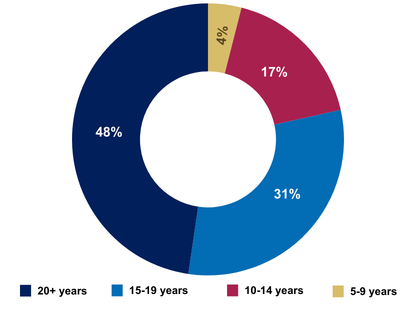
Past participants of the Emerging CFO Program
Work experience
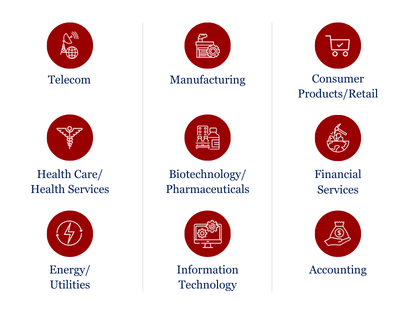
Top industries
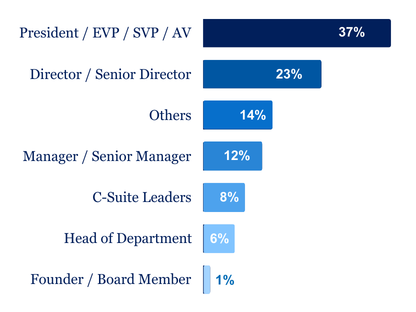
Top roles
Top countries
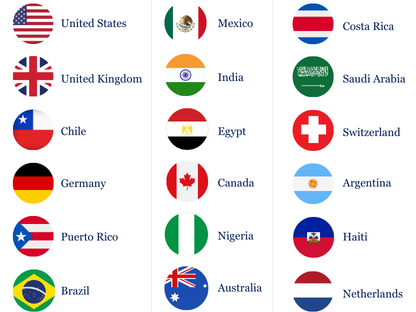
What past participants have to say about the Emerging CFO Program
Who teaches the Emerging CFO Program?

Itay Goldstein, PhD
Academic Director; Joel S. Ehrenkranz Family Professor; Professor of Finance; Professor of Economics; Chairperson, Finance Department
Itay Goldstein is an expert in the areas of corporate finance, financial institutions, and financial markets, focusing on financial fragility and crises and on the feedback ef...

Chris Geczy, PhD
Adjunct Professor of Finance; Academic Director, Wharton Wealth Management Initiative; Academic Director, Jacobs Levy Equity Management Center for Quantitative Financial Research

Anthony Landry, PhD
Adjunct Full Professor of Finance; Deputy Vice Dean, MBA Program

Lindsey Cameron, PhD
Assistant Professor of Management Dorinda and Mark Winkelman Distinguished Faculty Scholar

Marissa King, PhD
Alice Y. Hung President’s Distinguished Professor
Marissa King’s research focuses on deciphering the complexities of human interactions within the context of health care organizations, teams, and broader social structures. He...

Mauro Guillén, PhD
William H. Wurster Professor of Multinational Management Vice Dean, MBA Program for Executives

Witold Henisz, PhD
Vice Dean and Faculty Director, ESG Initiative; Deloitte & Touche Professor of Management in Honor of Russell E. Palmer, former Managing Partner

Rahul Kapoor, PhD
David W. Hauck Professor at the Wharton School Professor of Management Chairperson, Management Department

Harbir Singh , PhD
Mack Professor; Professor of Management; Co-Director, Mack Institute for Innovation Management; Faculty Director, Huntsman Program

Kevin Kaiser, PhD
Adjunct Full Professor of Finance; Senior Fellow, Harris Family Alternative Investments Program
Note: Faculty list is subject to change.
What credentials and outcomes will you gain from the Emerging CFO Program?
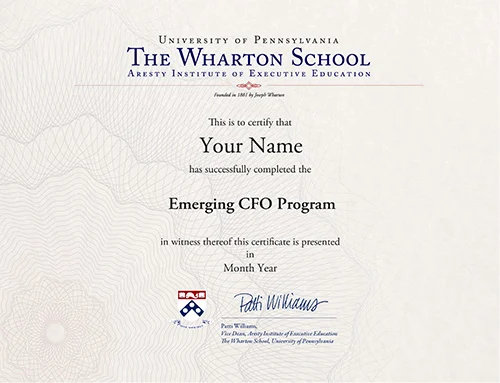
Certificate of completion
Earn a Wharton Executive Education digital certificate upon successful completion of the Emerging Chief Financial Officer Program. Participants of this transformative program get exclusive access to a wide range of professionals, events, and networking opportunities.
Note: After successful completion of the program, your verified digital certificate will be emailed to you in the name you used when registering for the program. All certificate images are for illustrative purposes only and may be subject to change at the discretion of the Wharton School.
Please also note that participation in the Emerging CFO Program (a) will not result in a degree from, alumni status, or earned credit at the University of Pennsylvania or the Wharton School (or, to Wharton’s knowledge, any other institution), (b) will not be recorded on a University of Pennsylvania or Wharton transcript, and (c) does not guarantee or suggest that a participant will be admitted to the University of Pennsylvania, the Wharton School, or any other university or institution.
FAQs
Why Wharton Executive Education?
Wharton Executive Education delivers research-driven programs that prepare finance leaders to act as strategic partners and guide enterprise growth. With access to world-renowned faculty and practical insights on corporate finance, capital markets, and emerging trends, participants gain the leadership skills and financial expertise to strengthen strategy, enhance performance, and drive organizational excellence on a global scale.
How do CFOs address corporate governance and corporate restructuring challenges?
CFOs are central to corporate governance and corporate restructuring by ensuring financial stability, strengthening capital allocation, and supporting strategic initiatives that drive business excellence. They bring financial expertise, strategic skills, and leadership to complex decisions that impact business performance and long-term value creation.
Executive education programs such as the Wharton Emerging Chief Financial Officer Program prepares senior finance executives to navigate these responsibilities with a deeper understanding of corporate finance, capital markets, and financial transformation, enabling them to act as effective strategic partners to key stakeholders. Check the program page for more details.
What capabilities can professionals develop through a financial leadership program?
A strong financial leadership program should help professionals strengthen their ability to make strategic financial decisions, manage organizational complexity, communicate effectively with stakeholders, and lead transformation in rapidly evolving business environments. It should also help finance leaders balance financial performance, innovation, governance, and long-term organizational priorities.
The Emerging Chief Financial Officer Program from Wharton Executive Education enables professionals to develop capabilities in financial leadership, corporate finance, strategic decision making, risk management, capital allocation, ESG integration, and enterprise-wide collaboration. Participants also gain practical insights into mergers and acquisitions, global finance, financial transformation, and leadership development through live sessions, executive networking, and applied learning experiences.
What is the Emerging CFO Program at Wharton Executive Education?
The Emerging CFO Program from Wharton Executive Education is a six- to eight-month learning journey for experienced financial leaders and senior finance executives. It combines core modules in leadership and corporate finance strategy, and specialized modules on capital markets, international finance, and financial transformation. Participants sharpen financial expertise, develop strategic mindset, and build the leadership capabilities needed to succeed as future chief financial officers.
What is the best school to become a CFO?
Many top business schools offer executive education programs that can help financial leaders prepare for the C-suite. The right choice depends on whether you are looking to deepen corporate finance expertise, strengthen leadership skills, or broaden your strategic mindset. The Wharton Emerging Chief Financial Officer Program is designed specifically for professions working in corporate finance, financial account or financial planning and analysis, combining financial leadership, corporate strategy, and emerging trends to prepare you for the demands of the CFO role.
How much does the Wharton Emerging CFO Program cost?
The program fee for the Wharton Emerging Chief Financial Officer Program can be found on the program page. This program fee covers academic content, online coursework, and faculty interaction. Travel, accommodation, and the optional on-campus networking event fee are additional. Flexible payment options and early application benefits may also be available for participants. Check the program page for more details.
What is the best course to become a CFO?
The best course to become a CFO varies depending on your career stage, current responsibilities, and the capabilities you want to develop. Many business schools offer programs that emphasize financial expertise, corporate governance, and leadership development. The Wharton Emerging Chief Financial Officer Program blends finance strategy and leadership skills with a comprehensive curriculum, enabling finance leaders to advance toward senior finance roles with clarity and confidence.
What certification do you need to be a CFO?
Chief financial officers come from a variety of educational and professional backgrounds, and there is no single required certification. Many pursue credentials such as CPA, CFA, or MBA from top business schools, which help build strong technical and analytical foundations. However, while certifications validate professional expertise, professional certificates are designed to deepen strategic perspective, leadership capability, and enterprise-wide thinking.
Executive education programs, such as the Wharton Emerging CFO Program, build on those foundations by equipping finance professionals with financial leadership, strategic decision-making, and enterprise-wide influence to succeed in C-suite roles.
How do you train to be a CFO?
Training to become a chief financial officer is less about a single path and more about building a blend of technical expertise, leadership skills, and strategic financial insight. Many senior finance executives prepare by gaining experience in areas like corporate finance, financial planning, and capital markets, while also strengthening their ability to lead teams and influence enterprise decisions. You will find several executive education programs from top business schools. The Wharton Emerging CFO Program offers a structured way to develop the strategic mindset and leadership capabilities needed for C-suite roles.
I have a full-time job. What is the expected time commitment?
The Emerging CFO Program has been designed with your busy schedule in mind. You will be required to commit not more than three to five hours per week, enabling you to benefit from this transformative program while fulfilling your day-to-day work responsibilities. The impactful program offers a blend of self-paced modules and live interaction.
How do the live sessions work?
The six- to eight-month learning journey includes live webinars as well as live online and asynchronous sessions with renowned faculty, industry experts, and global peers. You can take advantage of weekly live sessions and the Slack channel to ask questions and discuss ideas with your success coach and cohort participants. Real-world examples and a debrief of the program learnings are delivered through a combination of recorded video and live online lectures. The program concludes with an optional two-day on-campus graduation and networking event on the University of Pennsylvania campus in Philadelphia.
What is included in the price of the program?
The program fee covers teaching fees, all academic material, and access to online coursework. The fee does not include the registration fee of US$250 for the optional two-day on-campus networking and recognition ceremony, accommodation expenses for the on-campus event, travel expenses (domestic and international, including visa fees), and any other expenses not specifically mentioned in the program fees.
Is a discount or financial aid available?
You can pay the full program fee upfront or pay in easy installments. If you apply well in advance of the program start date, you can receive a tuition fee benefit. If you would like to approach your company with a sponsorship request for this program, here is a customizable template that you can use.
Does the program offer closed captioning for videos included in the curriculum?
Yes. We provide closed captioning and transcripts for all pre-recorded videos as well as closed captioning for recordings of live sessions.
Who will be collecting payment for the program?
Emeritus collects all program payments, provides learner enrollment and program support, and manages learning platform services.
Where can I find the program refund and deferral policy?
For the program refund and deferral policy, please click here.
Are there any restrictions on the types of funding that can be used to pay for the program?
Program fees for Emeritus programs with Wharton and Emeritus may not be paid for with (a) funds from the GI Bill, the Post-9/11 Educational Assistance Act of 2008, or similar types of military education funding benefits or (b) Title IV financial aid funds.
How does a finance leadership program prepare executives for strategic financial leadership?
A finance leadership program helps experienced finance professionals move beyond functional expertise toward broader enterprise responsibilities.
The Wharton Emerging Chief Financial Officer Program combines the depth of a strategic finance course with leadership development, covering capital allocation, financial risk, corporate strategy, and organizational influence. Designed for professionals pursuing strategic financial leadership, the program includes faculty-led sessions, specialized CFO modules, and a capstone project that strengthens participants' ability to evaluate complex financial decisions and contribute to long-term value creation.
What should senior finance executives look for in a CFO leadership program?
An effective CFO leadership program should combine advanced financial expertise with the strategic perspective and leadership capabilities required for C-suite responsibilities. Professionals exploring a CFO development program or senior finance leadership program should consider the curriculum's coverage of corporate finance, risk management, organizational transformation, and stakeholder influence.
The Wharton Emerging Chief Financial Officer Program offers a structured approach to CFO executive education, bringing together finance and management leadership development through core modules, specialized learning, and practical application. It addresses the broader capabilities professionals may seek in a finance management leadership program, preparing them to navigate enterprise-level financial decisions and organizational priorities.
How does Emeritus support accessibility for learners?
Emeritus is committed to making high-quality education accessible and affordable to individuals, companies, and governments around the world. If you have questions about accessibility or would like to discuss available support options before enrolling, please contact accessibility@emeritus.org. For more information about our accessibility practices, please review our Accessibility Policy here.
Connect with a program advisor for a 1:1 session
Our program advisors have helped senior executives across the world choose the right program for their career goals. Schedule a 1:1 to get a deeper understanding of why the Emerging CFO Program is the right fit for you.
Email: learner.success@emeritus.org
Phone: +1 315 847 4592 (U.S.) / +44 782 202 6595 (U.K.) / +65 3138 6189 (S.G.)
Early applications are encouraged. Admissions are reviewed on a first-come, first-served basis.
Flexible payment options available.
Starts On