


Management Development Program
Gain a comprehensive management perspective across finance, marketing, strategy, operations, and more
Program Overview
The best managers and leaders today think across financial, operational, strategic, and human dimensions at the same time, and move fluently between them as decisions demand.
Wharton's online Management Development Program is a 12-week online program designed to help you build that managerial mindset. Led by more than 10 world-class Wharton faculty, the program covers the needed management breadth with a curriculum that spans finance and accounting, marketing, strategy, operations, and organizational design — helping you understand how these disciplines intersect in real-world business decisions. Additionally, through faculty-led, AI-focused live webinars, you will gain insights into how AI is transforming core areas of business and management. Through a Managerial Action Plan capstone, apply the full curriculum to a real challenge within your organization, developing strategies that translate learning into measurable business impact.
Key takeaways of the Management Development Program
The program will enable you to:
Analyze organizations and teams using systems thinking, alignment models, and job-design frameworks to recommend improvements
Craft communication and trust-building strategies to motivate, engage, and collaborate with stakeholders
Interpret financial statements and evaluate organizational performance using accounting principles, profitability ratios, and variance analysis
Develop strategies for marketing, customer centricity, and organizational growth that enhance value creation
Apply financial and operational decision-making tools to recommend initiatives that improve efficiency and enterprise value
Create a personal leadership and career development plan aligned with your values, success metrics, and long-term goals
Explore how AI is reshaping core business functions and identify potential implications to decide where to adapt and how to lead
What you will learn in the Management Development Program
The Management Development Program delivers a structured 12-module online learning experience designed to help professionals navigate increasingly cross-functional responsibilities. Through the curriculum, you will develop a broader understanding of how strategy, finance, marketing, operations, and organizational design intersect to shape real-world business decisions.
1
Module 1: Foundations of Management Thinking
Develop the systems perspective required to understand how strategy, structure, incentives, and behavior interact to influence organizational performance. Gain the frameworks leaders use to diagnose alignment challenges and guide enterprise decision making.
Key topics include:
Systems thinking
Understand how interconnected organizational elements influence outcomes and shape leadership decisions.
The organization as a system
Examine how strategy, structure, processes, and people interact to affect enterprise performance.
Nadler-Tushman Congruence Model
Use a proven alignment framework to diagnose gaps between organizational components and performance goals.
Strategic alignment
Learn how leaders ensure strategy, capabilities, and incentives reinforce organizational priorities.
Intrinsic and extrinsic motivation
Explore how different motivation drivers influence engagement, performance, and leadership effectiveness.
Behavioral science in the workplace
Apply insights from behavioral research to understand how people make decisions and respond to incentives at work.
2
Module 2: Power, Influence, and Decision Making
Strengthen your ability to influence outcomes and guide decisions in complex organizational environments. Explore how leaders navigate power dynamics, apply ethical influence, and improve decision quality across teams and stakeholders.
Key topics include:
Foundations of power
Understand the sources of power within organizations and how leaders use them to influence decisions and outcomes.
Ethical influence
Learn how to guide decisions responsibly while maintaining trust, credibility, and organizational alignment.
Biases in decisions
Recognize common cognitive biases that affect leadership judgment and apply techniques to improve decision quality.
3
Module 3: Effective Team Design and Job Architecture
Examine how leaders design roles, teams, and performance systems that enable collaboration, accountability, and sustained organizational performance.
Key topics include:
Job design
Learn how structuring roles and responsibilities can improve engagement, productivity, and organizational effectiveness.
Performance systems
Understand how performance management frameworks guide behavior and reinforce organizational priorities.
Psychological safety
Explore how leaders create environments in which teams can communicate openly, collaborate effectively, and innovate.
Team structures
Analyze different team configurations and how they influence coordination, accountability, and performance.
Incentive design
Examine how compensation and recognition systems shape motivation and drive desired organizational outcomes.
4
Module 4: Stakeholder Communication and Trust Building
Develop the communication capabilities required to build trust, strengthen relationships, and align stakeholders around shared organizational priorities.
Key topics include:
Active listening
Strengthen your ability to understand perspectives, uncover insights, and guide productive leadership conversations.
Trust building
Learn how leaders build credibility and maintain trust across teams, stakeholders, and organizational relationships.
Storytelling
Use structured narratives to communicate ideas clearly and influence stakeholders effectively.
Communication tools
Apply practical frameworks that support clarity, alignment, and effective communication in leadership settings.
5
Module 5: Organizational Networks and Influence
Examine how informal relationships and influence networks shape decision making within organizations. Understand how coalitions and social structures influence outcomes across teams and functions.
Key topics include:
Informal networks
Analyze how relationships and influence patterns within organizations shape collaboration and decision flows.
Coalitions
Understand how alliances form within organizations and how leaders build support for strategic initiatives.
Navigating politics
Assess organizational dynamics and guide decisions effectively while maintaining credibility and trust.
6
Module 6: Foundations of Accounting for Managers
Develop the financial perspective required to interpret organizational performance and support informed business decisions.
Key topics include:
Balance sheets
Examine how assets, liabilities, and equity reflect an organization’s financial position.
Income statements
Analyze how revenue, costs, and profitability indicators signal business performance.
Cash flows
Understand how cash movement reveals the financial health and sustainability of operations.
Budgeting
Assess how budgeting frameworks guide planning, accountability, and resource allocation.
7
Module 7: Analyzing Financial Performance
Strengthen your ability to evaluate operational and financial outcomes using structured financial analysis frameworks.
Key topics include:
Financial ratios
Assess organizational performance through key indicators, including profitability, efficiency, and leverage.
Variance and margin analysis
Analyze performance deviations to identify operational drivers and improvement opportunities.
Profitability
Examine how pricing, cost structures, and operational efficiency influence financial outcomes.
8
Module 8: Financial Decision-Making Tools
Explore how leaders evaluate investments, allocate resources, and guide strategic initiatives using financial decision frameworks.
Key topics include:
Time value of money
Understand how cash flow timing influences investment and financing decisions.
Net present value
Evaluate investment opportunities by assessing the long-term value they generate.
Internal rate of return
Analyze projected returns to compare and prioritize competing investment opportunities.
Capital budgeting
Assess how organizations allocate financial resources across strategic initiatives and projects.
9
Module 9: Marketing Strategy, Customer Centricity, and Experience
Examine how customer insights and strategic positioning influence competitive advantage and long-term growth.
Key topics include:
Segmentation
Analyze how organizations identify and prioritize distinct customer groups.
Positioning
Assess how brands differentiate their offerings and communicate value in competitive markets.
Customer value
Examine how organizations create and deliver value that strengthens loyalty and market position.
Jobs to be done
Explore how understanding customer motivations informs product development and innovation.
Customer-experience touchpoints
Analyze the interactions that shape customer experiences across the full journey.
Personalization
Assess how tailored experiences enhance engagement and strengthen customer relationships.
Loyalty
Examine how organizations design strategies that sustain long-term customer relationships.
10
Module 10: Strategic Thinking
Develop the strategic perspective required to evaluate competitive positioning and guide long-term organizational direction.
Key topics include:
Competitive strategy frameworks (Porter, Blue Ocean, and disruptive innovation)
Analyze frameworks that help leaders evaluate competitive positioning and industry dynamics.
Identifying and avoiding growth traps
Assess strategic risks that can limit sustainable organizational growth.
Strategic trade-offs in resource allocation
Examine how leaders prioritize investments and allocate resources across competing opportunities.
Evaluating long-term positioning and advantage
Understand how organizations sustain competitive advantage over time.
11
Module 11: Operations Management and Process Thinking
Discover how operational systems and process design influence efficiency, scalability, and organizational performance.
Key topics include:
Bottlenecks
Identify operational constraints that limit productivity and slow organizational performance.
Little’s Law
Analyze how throughput, cycle time, and work-in-progress affect operational efficiency.
Service operations
Examine how service processes can be structured to improve reliability and customer outcomes.
Automation
Explore how technology and automation improve efficiency and support scalable operations.
12
Module 12: Managing Yourself — Values, Success, and Impact
Reflect on the leadership choices that shape long-term career direction and organizational impact.
Key topics include:
Values-based leadership
Examine how personal values influence leadership decisions and professional integrity.
Personal success
Assess how leaders define and measure success across professional and personal dimensions.
Career planning
Explore strategies for aligning career decisions with long-term goals and leadership aspirations.
Reflection frameworks
Apply structured reflection to evaluate experiences and guide future leadership choices.
Well-being tools
Discover practices that support resilience, balance, and sustained leadership performance.
Note: Module topics are subject to change.
Hear from our participants
The best part of the Wharton Management Development Program was how comprehensive and immediately applicable the learning was. Each module built on the next — covering leadership, finance, marketing, operations, and strategy — in a way that gave me practical frameworks to think, decide, and lead differently. I especially valued how the program challenged me to reflect on my managerial mindset and align my strengths with future leadership opportunities. Overall, the program gave me both the confidence and the tools to successfully pivot into a new industry while deepening my effectiveness as a manager and leader....
Konstantinos Perakis
General Manager, Sales and Events Manager
This program covers all or pretty much everything that is needed to accelerate towards the managerial role. And for the ones already in the role, it's definitely a great source to polish skills.
Mekala Mohan
HR-Accounting Manager,
The best part for me was the module on Managing Yourself, because it helped me to re-assess myself and my goals, and draft the best possible work-life balance approach.
Edidong Akpan
Territory Sales Manager
Weekly activities which helped to practice the concepts, flexible and structured learning, and really great examples to reinforce the concepts.
Vijayakumar Gopalakrishnan
Engagement Director, Salesforce
Live AI webinar series: practical insights for a changing business landscape
As part of the program, you will access expert-led, live, AI-focused webinars examining how emerging technologies are transforming core areas of business. Across marketing, management, and finance, you will explore how AI is influencing customer behavior, organizational decision-making, and financial strategy. You will gain clarity on where disruption is taking hold, how organizations are responding, and what actions to consider.

AI and the Evolving Role of Management
AI is reshaping how work gets done, how organizations are structured, and how leaders operate. This session explores what these shifts mean in practice. You will examine AI’s impact on innovation, collaboration, and workflows, and how leaders can adapt.
AI and Strategic Financial Decision-Making
AI is expanding how organizations analyze information, assess risk, and make financial decisions while introducing new complexities. This session focuses on how AI is shaping financial thinking. You will explore its impact on forecasting, investment decisions, and risk management.
AI and the Changing Marketing Landscape
AI is rapidly changing how customers discover, evaluate, and engage with brands. This session examines what that means in practice. You will explore how strategies are evolving, where traditional approaches may fall short, and how managers can adapt.
Note: The topics are indicative and subject to change based on speaker availability.
Capstone — A Managerial Action Plan
Apply each week’s concepts to real challenges drawn from your own organization. These weekly applications build progressively across modules, developing a practical management tool kit grounded in your own context. By the end of the program, this cumulative work forms your Managerial Action Plan — a comprehensive, execution-ready resource you can draw on across your leadership responsibilities.
You will:
Define high-impact challenges within your organization
Conduct a structured diagnosis using cross-functional frameworks
Design a clear, financially and strategically grounded action plan
Develop implementation steps aligned with stakeholders and incentives
Build a practical managerial tool kit that you can apply long after the program ends
By the end of the program, you will leave with a concrete initiative ready to implement and a repeatable approach to addressing complex management challenges.
Program highlights

Integrated management curriculum
Develop a broad management perspective through a structured 12-module curriculum spanning organizational design, influence, finance, marketing, operations, and competitive strategy.

Navigating power and influence
Apply power and influence frameworks to guide ethical decision making and navigate complex stakeholder dynamics.

Enterprise systems thinking
Analyze organizations as interconnected systems and identify how structure, incentives, and strategy align to shape enterprise performance.

Decision-making frameworks
Apply proven frameworks to diagnose organizational challenges, evaluate strategic trade-offs, and guide enterprise-level decisions.

Managerial Action Plan
Address real business challenges across modules and develop an execution-ready tool kit grounded in strategy, finance, operations, and leadership insights.

10+ Wharton faculty and experts
Learn from a distinguished group of Wharton faculty and experts whose research and insights shape how organizations approach leadership, strategy, and enterprise performance.

Live AI webinar series
Expert-led, live webinars exploring how AI is influencing marketing, management, and finance, and what it means for decision-making, strategy, and organizational response.

Global peer group
Engage with and learn alongside accomplished peers from around the globe and gain new approaches to leadership.
Faculty and experts
The program brings together more than 10 Wharton faculty and experts whose research and insights influence how organizations approach leadership, strategy, and enterprise performance. Drawing on their expertise across management, finance, marketing, operations, and strategy, they will guide you through the frameworks and decisions that shape effective enterprise leadership.

Lori Rosenkopf
Simon and Midge Palley Professor; Professor of Management; Academic Director of the CTO Program, Wharton Executive Education; Vice Dean of Entrepreneurship, The Wharton School
Lori Rosenkopf is the vice dean of entrepreneurship and is responsible for leading the Venture Lab at the University of Pennsylvania, a resource for Penn students and alumni i...

Maurice Schweitzer
Cecilia Yen Koo Professor; Professor of Operations, Information and Decisions; Professor of Management, The Wharton School; Academic Director of Effective Decision Making, a Wharton Executive Education Program
Maurice Schweitzer is the Cecilia Yen Koo Professor and a professor of operations, information, and decisions and of management at the Wharton School of the University of Penn...

Patti Williams
Ira A. Lipman Associate Professor of Marketing; Vice Dean, Wharton Executive Education, The Wharton School
Patti Williams’ research explores how emotional responses shape consumer behavior and influence persuasion. Her current work examines how emotions impact decision making, how ...

Nicolaj Siggelkow
David M. Knott Professor; Professor of Management; Co-Director, Mack Institute for Innovation Management; Vice Dean, MBA Program
Nicolaj Siggelkow’s research focuses on the strategic and organizational implications of how organizations design, evolve, and align their activities and resources. His work e...

G. Richard Shell
Thomas Gerrity Professor; Professor of Legal Studies & Business Ethics; Professor of Management, The Wharton School

Peter Cappelli
George W. Taylor Professor of Management; Director, Center for Human Resources, The Wharton School

Henning Piezunka
Associate Professor of Management, The Wharton School

Jennifer Blouin
Richard B. Worley Professor of Financial Management; Professor of Accounting; EY Professor of Accounting; Chairperson, Department of Accounting, The Wharton School

Christopher Geczy
Adjunct Full Professor of Finance; Academic Director, Wharton Wealth Management Initiative; Academic Director, Jacobs Levy Equity Management Center for Quantitative Financial Research, The Wharton School

Hummy Song
Associate Professor of Operations, Information and Decisions, The Wharton School

Richard Lambert
Miller-Sherrerd Professor; Professor of Accounting, The Wharton School
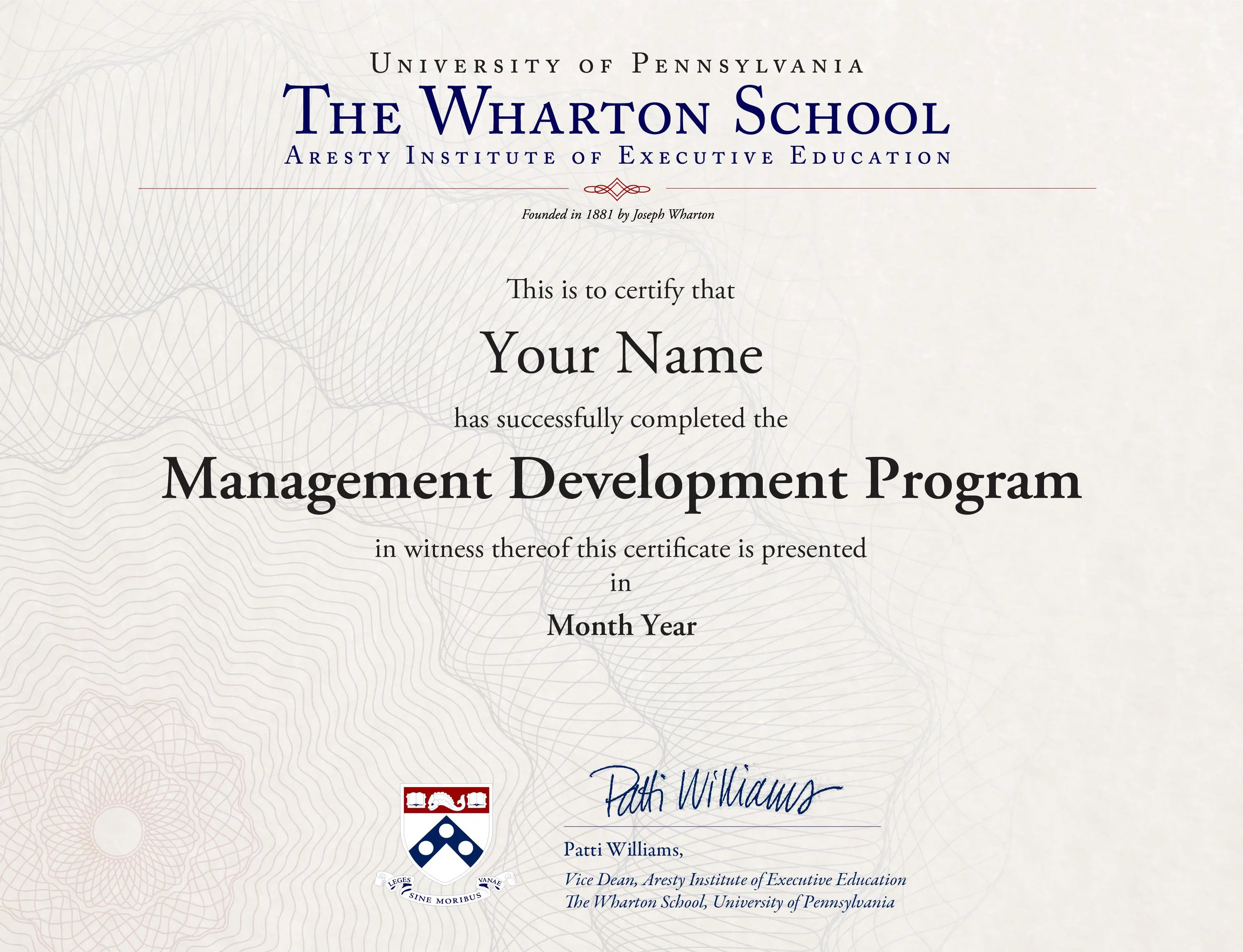
Certificate
Upon successful completion of the program, you will earn a digital certificate of completion from the Wharton School.
Note: After successful completion of the program, your verified digital certificate will be emailed to you in the name you used when registering for the program. All certificate images are for illustrative purposes only and may be subject to change at the discretion of the Wharton School. Please also note that participation in the Management Development Program (a) will not result in a degree from, alumni status with, or earned credit at the University of Pennsylvania or the Wharton School (or, to Wharton’s knowledge, any other institution); (b) will not be recorded on a University of Pennsylvania or Wharton transcript; and (c) does not guarantee or suggest that a participant will be admitted to the University of Pennsylvania, the Wharton School, or any other university or institution.
Receive an executive certificate with this learning journey
Executive Presence and Management Development Program
Maximize your learning: Drive impact with the Executive Presence and Management Development Program
Elevate your leadership effectiveness with a comprehensive learning journey that combines business acumen, cross-functional expertise, and executive presence. Develop the ability to analyze business challenges, influence decisions, and lead enterprise outcomes with clarity and confidence.

FAQs
1
The program
How do I know if this program is right for me?
After reviewing the information on the program landing page, we recommend you submit the short form above to gain access to the program brochure, which includes more in-depth information. If you still have questions on whether this program is a good fit for you, please email learner.success@emeritus.org, and a dedicated program advisor will follow-up with you very shortly.
Are there any prerequisites for this program?
Some programs do have prerequisites, particularly the more technical ones. This information will be noted on the program landing page, as well as in the program brochure. If you are uncertain about program prerequisites and your capabilities, please email us at the ID mentioned above.
Note that, unless otherwise stated on the program web page, all programs are taught in English and proficiency in English is required.
What is the typical class profile?
More than 50 percent of our participants are from outside the United States. Class profiles vary from one cohort to the next, but, generally, our online certificates draw a highly diverse audience in terms of professional experience, industry, and geography — leading to a very rich peer learning and networking experience.
What other dates will this program be offered in the future?
Check back to this program web page or email us to inquire if future program dates or the timeline for future offerings have been confirmed yet.
2
The learning experience
How much time is required each week?
Each program includes an estimated learner effort per week. This is referenced at the top of the program landing page under the Duration section, as well as in the program brochure, which you can obtain by submitting the short form at the top of this web page.
How will my time be spent?
We have designed this program to fit into your current working life as efficiently as possible. Time will be spent among a variety of activities including:
Engaging with recorded video lectures from faculty
Attending webinars and office hours, as per the specific program schedule
Reading or engaging with examples of core topics
Completing knowledge checks/quizzes and required activities
Engaging in moderated discussion groups with your peers
Completing your final project, if required
The program is designed to be highly interactive while also allowing time for self-reflection and to demonstrate an understanding of the core topics through various active learning exercises. Please email us if you need further clarification on program activities.
What is it like to learn online with the learning collaborator, Emeritus?
More than 350,000 learners across 80 countries have chosen to advance their skills with Emeritus and its educational learning partners. In fact, 90 percent of the respondents of a recent survey across all our programs said that their learning outcomes were met or exceeded.
All the contents of the course would be made available to students at the commencement of the course. However, to ensure the program delivers the desired learning outcomes the students may appoint Emeritus to manage the delivery of the program in a cohort-based manner the cost of which is already included in the overall course fee of the course.
A dedicated program support team is available 24/5 (Monday to Friday) to answer questions about the learning platform, technical issues, or anything else that may affect your learning experience.
How do I interact with other program participants?
Peer learning adds substantially to the overall learning experience and is an important part of the program. You can connect and communicate with other participants through our learning platform.
3
Credentials
What are the requirements to earn the certificate?
Each program includes an estimated learner effort per week, so you can gauge what will be required before you enroll. This is referenced at the top of the program landing page under the Duration section, as well as in the program brochure, which you can obtain by submitting the short form at the top of this web page. All programs are designed to fit into your working life.
This program is scored as a pass or no-pass; participants must complete the required activities to pass and obtain the certificate of completion. Some programs include a final project submission or other assignments to obtain passing status. This information will be noted in the program brochure. Please email us if you need further clarification on any specific program requirements.
What type of certificate will I receive?
Upon successful completion of the program, you will receive a smart digital certificate. The smart digital certificate can be shared with friends, family, schools, or potential employers. You can use it on your cover letter, resume, and/or display it on your LinkedIn profile.
The digital certificate will be sent approximately two weeks after the program, once grading is complete.
Can I get the hard copy of the certificate?
No, only verified digital certificates will be issued upon successful completion. This allows you to share your credentials on social platforms such as LinkedIn, Facebook, and Twitter.
Do I receive alumni status after completing this program?
No, there is no alumni status granted for this program. In some cases, there are credits that count toward a higher level of certification. This information will be clearly noted in the program brochure.
How long will I have access to the learning materials?
You will have access to the online learning platform and all the videos and program materials for 24 months following the program start date. Access to the learning platform is restricted to registered participants per the terms of agreement.
4
Technical requirements
What equipment or technical requirements are there for this program?
Participants will need the latest version of their preferred browser to access the learning platform. In addition, Microsoft Office and a PDF viewer are required to access documents, spreadsheets, presentations, PDF files, and transcripts.
Do I need to be online to access the program content?
Yes, the learning platform is accessed via the internet, and video content is not available for download. However, you can download files of video transcripts, assignment templates, readings, etc. For maximum flexibility, you can access program content from a desktop, laptop, tablet, or mobile device.
Video lectures must be streamed via the internet, and any livestream webinars and office hours will require an internet connection. However, these sessions are always recorded, so you may view them later.
5
Payment process
Can I still register if the registration deadline has passed?
Yes, you can register up until seven days past the published start date of the program without missing any of the core program material or learnings.
What is the program fee, and what forms of payment do you accept?
The program fee is noted at the top of this program web page and usually referenced in the program brochure as well.
Flexible payment options are available (see details below as well as at the top of this program web page next to FEE).
Tuition assistance is available for participants who qualify. Please email learner.success@emeritus.org.
What if I don’t have a credit card? Is there another method of payment accepted?
Yes, you can do the bank remittance in the program currency via wire transfer or debit card. Please contact your program advisor, or email us for details.
I was not able to use the discount code provided. Can you help?
Yes! Please email us with the details of the program you are interested in, and we will assist you.
How can I obtain an invoice for payment?
Please email us your invoicing requirements and the specific program you’re interested in enrolling in.
Is there an option to make flexible payments for this program?
Yes, the flexible payment option allows a participant to pay the program fee in installments. This option is made available on the payment page and should be selected before submitting the payment.
How can I obtain a W9 form?
Please connect with us via email for assistance.
Who will be collecting the payment for the program?
Emeritus collects all program payments, provides learner enrollment and program support, and manages learning platform services.
Are there any restrictions on the types of funding that can be used to pay for the program?
Program fees for Emeritus programs with Wharton Executive Education may not be paid for with (a) funds from the GI Bill, the Post-9/11 Educational Assistance Act of 2008, or similar types of military education funding benefits or (b) Title IV financial aid funds.
6
Refund policy
What is the program refund and deferral policy?
For the program refund and deferral policy, please click the link here.
7
What is the Management Development Program?
The Management Development Program from Wharton Executive Education is a 12-week online program delivered through a structured 12-module curriculum, and is guided by more than 10 Wharton faculty and experts. It focuses on how leaders interpret organizational performance, evaluate trade-offs, and align teams and systems to support business outcomes.
As part of the learning experience, participants work on a capstone project where they apply each week’s concepts to real challenges drawn from their organization. This helps build a practical management toolkit as they engage with different challenges across modules. By the end of the program, this develops into a Managerial Action Plan, a comprehensive, execution-ready resource that can be used in the workplace.
8
Who is the Management Development Program designed for?
The Management Development Program from Wharton Executive Education is designed for professionals who are taking on broader responsibilities and are required to contribute to decisions that extend beyond their primary function.
It is relevant for mid- to senior-level managers, functional leaders, and experienced professionals who work across teams and contribute to organization-level outcomes. The program is suited for those looking to strengthen how they interpret business performance, work across functions, and apply structured approaches to complex challenges involving multiple areas of the organization.
9
What does the program fee for the Management Development Program reflect?
The program fee for the Management Development Program from Wharton Executive Education reflects the program’s comprehensive curriculum, world-class Wharton faculty, and the executive learning experience designed for working professionals. The program is delivered online over 12 weeks, allowing participants to strengthen their leadership capabilities while continuing their professional commitments. You can find the latest program fee and the start date at the top of the program page.
10
What are the different kinds of management programs available for working professionals?
There are several types of management programs designed for professionals looking to strengthen their leadership and business management capabilities. Traditional management programs may require participants to study full-time on campus for an extended period, while executive education programs are designed to provide similar insights through shorter, more flexible formats that allow professionals to continue working while they learn.
The Management Development Program from Wharton Executive Education is designed as an executive learning experience for working professionals seeking to expand their leadership perspective without stepping away from their careers. Delivered online, the program helps participants gain insights into strategy, finance, marketing, operations, and organizational leadership while engaging with a global cohort of experienced peers.
11
Do management programs offer networking opportunities and executive coaching?
Many management programs provide opportunities to connect with peers and expand professional networks. Depending on the format, these programs may also include executive coaching or peer-learning components designed to support leadership development.
The Management Development Program from Wharton Executive Education emphasizes meaningful networking opportunities through interaction with a global cohort of professionals from diverse industries. Participants engage in collaborative discussions and shared learning experiences that enrich the program experience. While the program focuses primarily on applied management frameworks and leadership insights, participants benefit from engagement with Wharton faculty and industry experts throughout the program.
12
How does Emeritus support accessibility for learners?
Emeritus is committed to making high-quality education accessible and affordable to individuals, companies, and governments around the world. If you have questions about accessibility or would like to discuss available support options before enrolling, please contact accessibility@emeritus.org. For more information about our accessibility practices, please review our Accessibility Policy here.
Didn't find what you were looking for? Write to us at learner.success@emeritus.org or Schedule a call with one of our Program Advisors or call us at +1 680 205 5118 (US) / +44 185 845 9995 (UK) / +65 3135 1422 (SG)
Flexible payment options available.
Starts On